
Make It Rain Science: The Water Cycle in a Bag STEM Adventure!
STEM (Science, Technology, Engineering and Mathematics) activities are additional learning by doing. They inspire curiosity, encourage critical thinking and teach essential skills for the future. Early STEM engagement introduces children to real life concepts, enhances problem solving skills and develops creativity. They learn through active exploration and play, interactive experiences that develop cognitive and social skills at a time when children are most open to learning them.
STEM challenges often involve creativity and teamwork – from building simple machines and coding robots to designing eco-friendly solutions or exploring chemical reactions. These experiences help children connect theory to real-world applications, showing them that science and math are not just subjects to study, but tools to shape the world.
By engaging in STEM activities, learners build confidence, resilience, and a growth mindset – learning to test, fail, and try again until they succeed. Most importantly, STEM learning nurtures innovation and empowers young minds to become the thinkers, inventors, and leaders of tomorrow.
STEM in schools goes beyond textbooks. It encourages students to ask questions, experiment, and think critically about how things work. Whether they’re coding a simple program, designing a bridge, or exploring the laws of motion, students learn through hands-on experiences that make learning engaging and meaningful.
One of the greatest strengths of STEM education is how it connects academic concepts to real-life applications. Students see how math and science are used in everyday life — from building sustainable cities to developing new medical technologies. This connection helps them understand the relevance of what they learn and sparks curiosity about future careers in innovation, research, and technology.
By introducing STEM early in education, schools empower students to become critical thinkers, innovators, and lifelong learners. They learn not just to consume technology, but to create it — becoming the designers, engineers, and problem-solvers who will shape our future world.
Let us see one such small experiment which will encourage students to connect and learn with curiosity.
“Make It Rain Science: The Water Cycle in a Bag STEM Adventure!
Importance of the Activity
Suppose you could see the water cycle through your kitchen window.
This Water Cycle in a Bag is using just a zip lock bag and some water.
This fun and simple STEM Activity for Kids helps little ones explore how water travels, transforms and even “rains” all in a few short days.
Get ready for curiosity, discovery, and hands-on science that brings big ideas to life.
How to Play
Participants: Individual or small groups
Age. Range: 5-12 years
Duration: 30 minutes setup;
several days of observation for full effect
Instructions Materials Needed:
- 1 Ziplock (resealable) bag
- Water
- Blue food coloring (optional, for visibility)
- Permanent marker
- Tape
Steps:
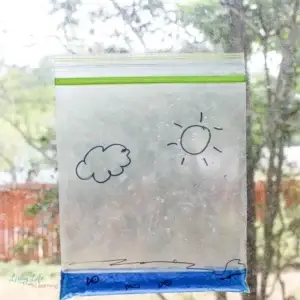
1. Use the marker to draw a sun, clouds, and other fun water cycle elements on the outside of the bag.
2. Fill the bag with about 1/4 cup of water. Add a few drops of food coloring to make the water stand out.
3. Seal the bag securely to prevent leaks.
4. Tape the bag to a sunny window.
5. Observe over the next few days:
Water will evaporate, condense on the inside surface of the bag, and then fall as “rain,” replicating the water cycle.
Discussion Prompts:
– Ask participants why some water seems to “disappear.”
– What is condensation?
– Why does the water later fall back down?
– Discuss where evaporation, condensation, and precipitation occur in nature.
Concluding Worksheet
|
Question |
Child’s Response |
|
What happened to the water in your bag? |
|
|
Where did you see condensation inside? |
|
|
What natural processes did you observe? |
|
|
Draw the stages of the water cycle. |
|
|
How does the water cycle affect weather? |
This worksheet reinforces understanding, encourages observation, and serves as a hands-on review of the water cycle’s stages: evaporation, condensation, and precipitation. Activities like these set the stage for STEM success and lifelong curiosity.
The Water Cycle in a Bag activity introduces children to earth science by visually showing evaporation, condensation, and precipitation. This experiment helps learners understand how water moves through our environment, reinforcing knowledge about natural processes that are key to daily life and climate science. Observing the water cycle firsthand encourages scientific inquiry and improves memory retention by connecting theory to real-world experiences.